
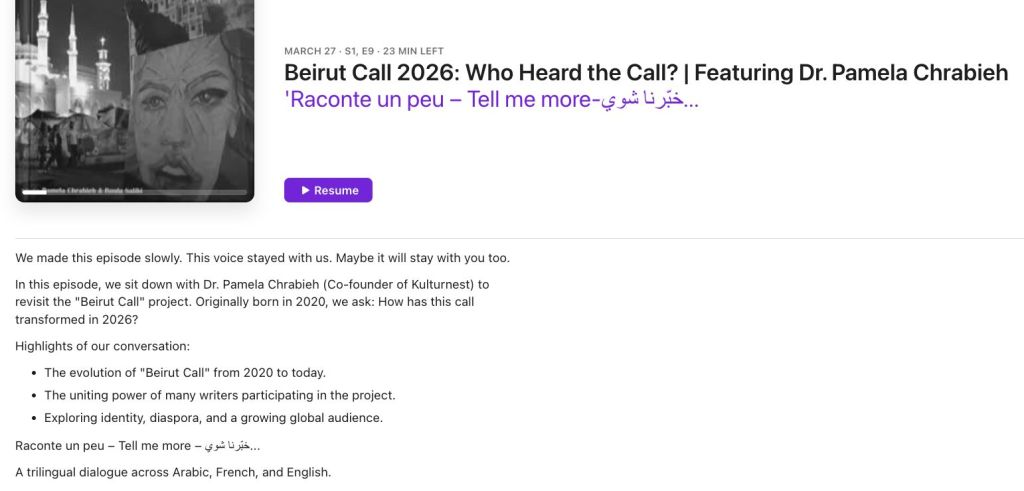
I had a thoughtful conversation with “Raconte un peu – Tell me more – خبّرنا شوي”- a trilingual book and culture podcast created by DC-based Pauline and Beirut-based Sandra Mehanna, two lovely sisters who open a generous space for dialogues on literature, memory, identity, and the ways stories move across languages, cultures, and lives.
Our exchange was not detached from the present. It took place as the south of Lebanon is under invasion, as bombardments continue, as fear circulates through the body before it even becomes language, and only a few hours after a building was hit not far from where we live. In such a context, speaking about a book is never only speaking about a book. It is also speaking about what remains possible when reality is pressing in from all sides.
We spoke about “The Beirut Call”, a book I co-edited, born in the aftermath of the Beirut port explosion in 2020 as part of the Nabad programme that I managed – part of Dar al-Kalima University’s projects – and published by Elyssar Press. That programme was conceived in response to the devastating impact of the explosion on Lebanon’s creative and cultural community, with the conviction that artists, writers, photographers, designers, and cultural actors are not peripheral in times of catastrophe. They are part of how a society grieves, remembers, resists erasure, and searches for meaning when the familiar structures of life begin to collapse.
This is what shaped the book from the beginning. The Beirut Call was never meant to produce one official narrative, one conclusion, or one lesson. It became a hybrid anthology of texts and artworks, a gathering of different voices, forms, and sensibilities responding to Beirut through testimony, reflection, poetry, visual language, and thought. What binds these contributions together is not sameness, but a shared refusal: a refusal of silence, simplification, and abstraction; a refusal to let human experience be flattened into headlines, numbers, or passing outrage.
What makes the book so painfully relevant today is precisely that it was never only about one explosion, one date, or one shattered moment…Today, in 2026, that dimension feels even sharper. The book now speaks not only to aftermath, but to continuity, to the reality of living inside crisis when crisis is no longer exceptional, but ongoing.
** Listen to the podcast (in Lebanese) HERE.
** About “The Beirut Call” book: https://lnkd.in/dZyKdzdT


Leave a Reply