Music exists in my memory as an acoustic architecture, built layer by layer alongside the image and the word, forming a triad of expression that I have never sought to disentangle. Since childhood, I have inhabited a polymorphic soundscape where boundaries between genres simply did not exist. My ears moved with a nomadic ease between the rigorous structures of classical music and opera, the raw friction of rock and blues, the syncopated freedom of jazz and bossa nova, and the microtonal depths of Arabic music, extending eventually into the fringes of experimental sound.
This immersion was never merely passive. At the age of six, I began a decade-long dialogue with the piano, a discipline that eventually led me to the Lebanese National Higher Conservatory of Music throughout the 1980s and 1990s. There, the study of solfège, Western vocal training, and lyrical singing became a second language – a period of national examinations and theoretical deep-dives that provided the skeletal structure for my later improvisations.
My public voice first found its resonance within the stone walls of Collège Notre-Dame de Jamhour and the Saydé church in Bikfaya. From early solo performances at age eight to co-founding the school choir, music was a communal rite, a way of anchoring myself in the heights of Mount Lebanon through Christmas concerts and liturgical cycles.
However, the university years in Lebanon shifted the frequency toward something more visceral. I performed with local bands in 1995-1996, then led a band called Cougars, navigating the sonic weight of heavy metal and the grit of soft rock and blues in the pubs of Beirut, Metn, and Keserwan until 1998. It was a time of creative friction, composing original songs for university festivals while simultaneously exploring the sophisticated nuances of jazz and bossa nova with the ALBA (Académie Libanaise des Beaux-Arts) band in 1999, alongside professors who shared that same hunger for musical hybridity.
Even my time in the Rotaract Club of Sahel Metn was punctuated by this melodic persistence; as president, I co-composed and performed an original piece at a regional gathering in Cyprus that was granted the award for Best Original Project. It was a reminder that even in the most structured environments, the song finds its way out.
Over the decades, whether in Lebanon or abroad, my voice has periodically surfaced in the work of other artists, contributing vocals to various albums as a guest in their sonic worlds. And while the visual arts eventually claimed a more central, public territory in my practice, music never retreated. It simply moved into the private interior, an ongoing, silent composition that continues to dictate the rhythm of everything I create. Music is not a skill I acquired; it is the pulse that keeps the rest of my work from falling into silence.
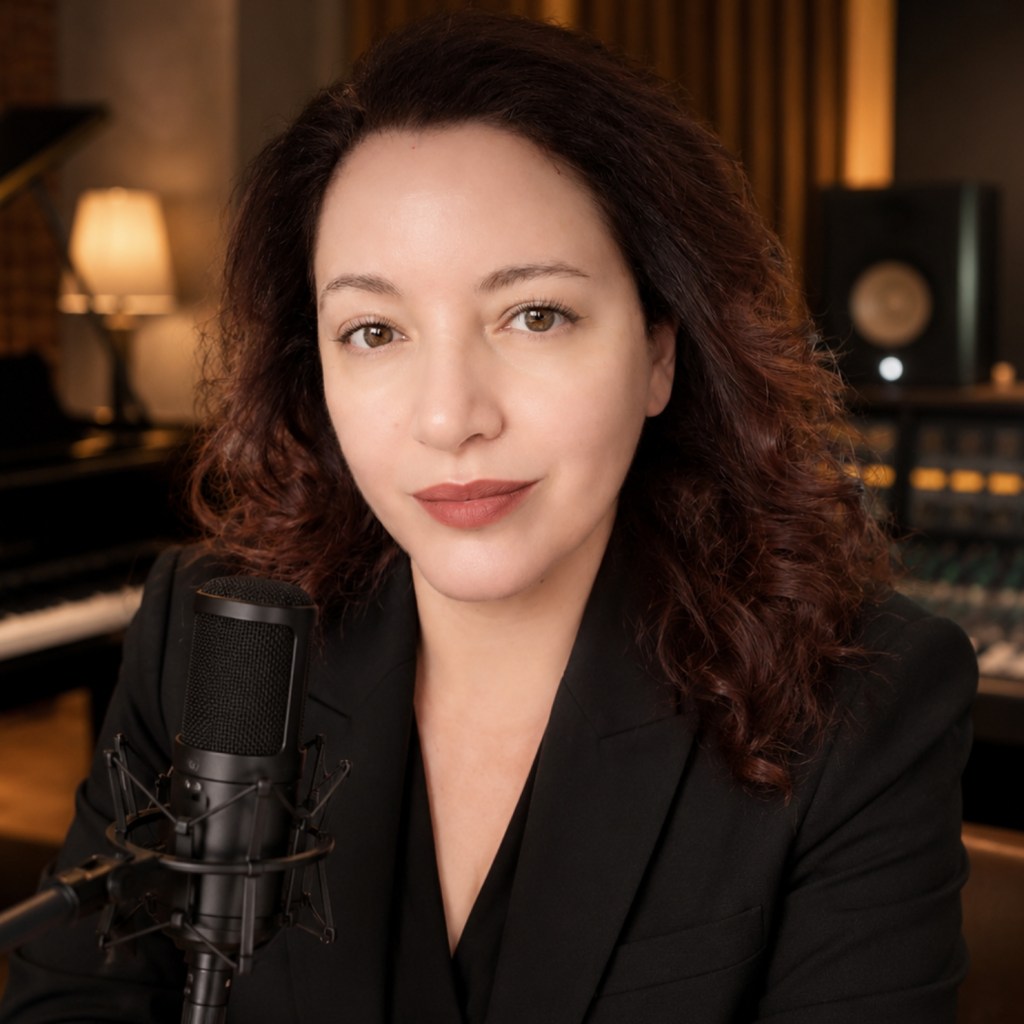
In April 2026, this internal resonance finally found its public voice with the release of two songs, Entre Nous and Génération Ma Fi Chi. Performed in both French and Lebanese, these compositions mark a return to music not as a departure from my visual practice, but as an essential expansion of the same creative inquiry. It is a reconciliation of languages, a convergence where sound and image speak the same dialect of a lifelong, singular journey.
In July 2026, Maalesh extended this journey through a blend of English and Lebanese, exploring grief, endurance, irony, and the fragile line between resilience and acceptance of the unacceptable. Also, Deux mondes, which is a song in French and Lebanese, born from a desire to create without separating music from what we are living through: war, fragmentation, the violence inflicted, but also the persistent pursuit of peace, justice, dialogue, conviviality, and humanity.
Together, these songs form a reconciliation of languages and a convergence in which sound and image speak the same dialect of a lifelong, singular journey.
Published in August 2026, “Ya Lebnan Ya Baladi (O Lebanon My Country)”, my fifth song of the year, is written in French and Lebanese. It was born from a refusal to turn resilience into destiny. When people are constantly praised for their ability to rise again, we sometimes forget their right not to keep falling. For me, engaged art begins there, not in slogans, but in the ability to name what hurts, to question what has been made to seem inevitable, and to preserve a demanding vision of peace and justice. This song is my way of saying that Lebanon deserves more than our courage: it deserves an ordinary, whole, and livable life.
I also published Yareyt in September 2026. “Yareyt” (يا ريت) is a Lebanese expression meaning “if only,” but it carries more than a simple wish: it holds longing, regret, hope, and the awareness of everything that stands in the way of change. My song explores that fragile threshold between private anger and collective action – the moment when frustration leaves our homes and conversations, one voice answers another, one step follows another, and something shared begins to take shape. It does not romanticize revolt or offer easy answers; it asks what might happen if, this time, we stopped waiting for someone else to begin.
My practice does not fragment into distinct disciplines; it operates as an integrated iconography, a continuous movement where music, visual arts, and writing are merely different frequencies of the same urgency. As a multiform, hybrid artist, I navigate the space between the materiality of the studio and the immateriality of the digital, treating the pixel as a pigment and sound as an additional layer of memory. This movement between the physical and virtual worlds is not a mere technical curiosity; it is a vital necessity to map the complexity of our fractured existences. Where language becomes saturated, and the image freezes, music intervenes as a force that bypasses representation to touch the very nerve of being. It offers a plasticity that the canvas does not always allow, a capacity for “deterritorialization” that prevents me from being locked within the physical or identity-based borders that others try to impose.
In the wake of the various “-cides” tearing through my homeland, my role as an artivist is not to decorate the disaster or feed the exhausting myth of “resilience” – that trap-word that demands a rebirth without scars. Instead, my work is an ethics of attention, a way of persisting in the rubble without succumbing to the anesthesia of indifference. Music, much like my installations and narratives, becomes a rampart against erasure. It serves as the emotional infrastructure that allows me to navigate horror without sinking into it, transforming the “ball of anger” into an audible vibration and the silence of disappeared villages into an indestructible sonic archive.
To be an engaged artist today is to use this hybridity to refuse the tabula rasa, tirelessly stitching together fragments of the virtual and the real so that, even in the heart of a phosphorus labyrinth, the human voice remains the ultimate sovereign territory.

