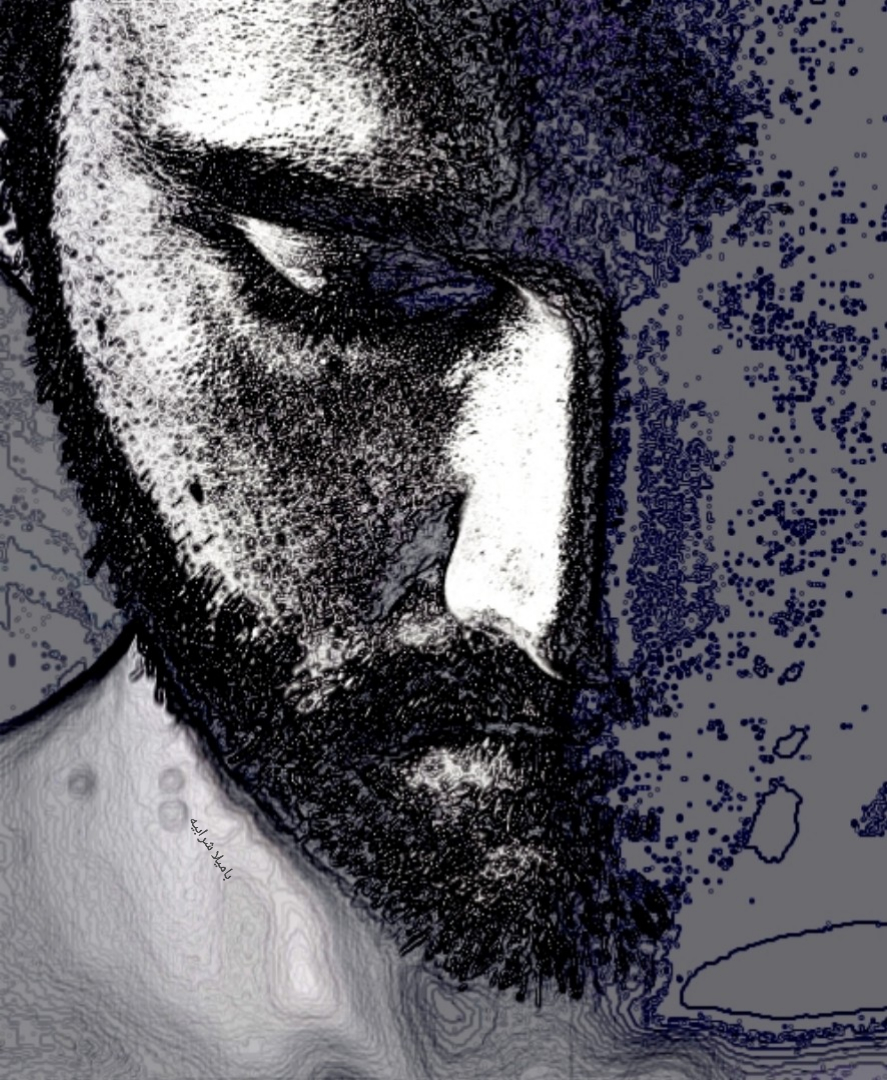
I created this hybrid artwork, “Scattered”, in 2020, following the Beirut port explosion. At that time, the city didn’t look like a city but like a nervous system that had been injured beyond repair and was somehow expected to go on living, to go on functioning. It was an atmosphere in which one quickly learned that catastrophe was not over after it happened. It was in matter, in language, in sleep, in skin, in memory. “Scattered” was made in that space, not really as a response to the explosion itself, but in an effort to think about what violence does to interiority, to the face, to identity, to that precarious architecture by which one stays somewhat whole.
The piece was subsequently published in *The Beirut Call*, an anthology that I co-edited and that was published by Elyssar Press (thank you, dear Katia AH) with the support of Dar al-Kalima University. It was part of the university’s Nabad programme that I was then running, and that was launched in late 2020 as a Lebanese-Palestinian response to the devastation of the blast, focusing on artists, cultural NGOs, and small creative businesses – especially those that were too independent, too emerging, too marginal, or too structurally neglected to ever comfortably fall within the orbit of institutional concern. The idea was simple, though simplicity can all too often be taken for naivety: that the arts aren’t a cosmetic adjunct to disaster. They are part of how we, as human beings, survive it, make sense of it, contest its appropriation of our meanings, and begin, in whatever piecemeal way, to rebuild ourselves from it.
This was also the larger framework in which The Beirut Call operated: a collective assertion that arts and culture are not important despite crisis but in fact because of, and sometimes even within, crisis. In the interview surrounding the book, I talked about the necessity for Lebanon to find ways to grow through the layers of wreckage from wars, explosions, and various crises; about the importance of arts and culture in constructing inclusive identities, memory, and understanding; about how humanitarian instincts often privilege the quantifiable urgency of crisis response but fail to understand or appreciate the slow work of symbolic repair, imaginative survival, and cultural transformation. I thought this back then. I think this even more strongly now.
What was the case in 2020 has not stopped being the case. If anything, it has been made more brutally visible. Lebanon remains in the long sentence of violence, while the broader region of Southwestern Asia remains scarred by wars, exile movements, militarized power, and the industrial production of precarity. The image of the face fragmenting into particles is no longer exclusive to Beirut after August 4. Tragically, it now belongs to a much broader geography of fracture. To lives that have been interrupted by bombardment, attrition, deportation, genoc***, humiliation… To lives that have been obliged to remain legible to themselves while history, politics, and violence do their best to scatter them into manageable debris.
I did not make “Scattered” as prophecy, and yet it comes back to me with that unpleasant familiarity that some works develop over time, as the world fails to learn from itself. The fact that it is relevant again today is not a source of pride. It is a condemnation of the cyclical nature of war, of the vulgarity of power, and of the global tendency to treat populations en masse as background to strategic stories. And yet, it is also, somehow, something else. A refusal. Because even in fragmentation, there is a face. Even in scattering, there is a hint of presence that cannot be erased…
#lebanon #wardiary
Further information about The Beirut Call: https://elyssarpress.com/books/p/the-beirut-call


 Dr. Pamela Chrabieh
Leave a comment