

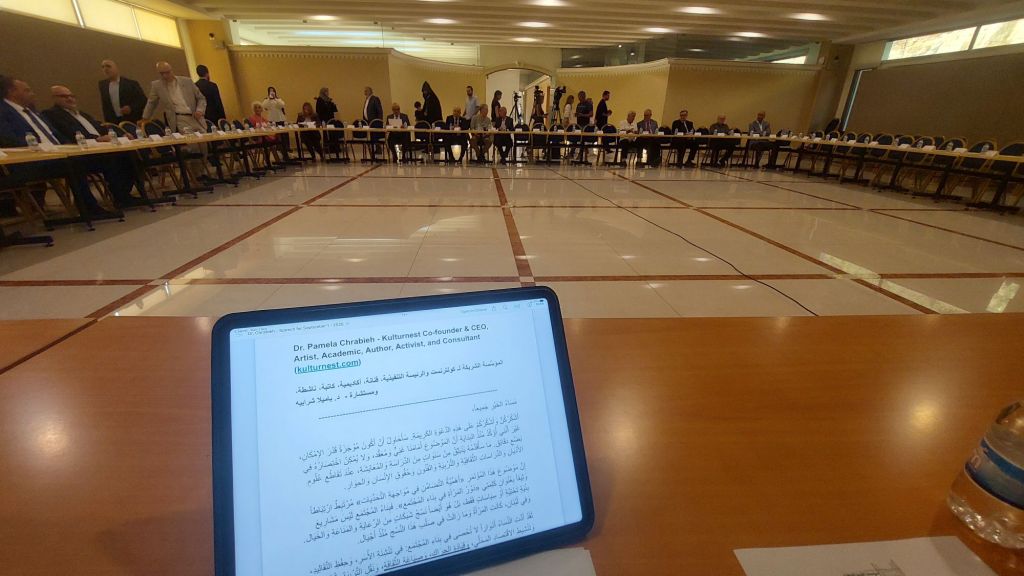
It was an honour to be invited to give a speech in Arabic at the roundtable organised on September 1, 2025, in the Liqaa Center, Rabieh, Lebanon, on the occasion of the 47th commemoration of the disappearance of Imam Musa al-Sadr, Sheikh Muhammad Yaacoub, and Abbas Badr al-Din. The event, organised by the Sheikh Muhammad Yaacoub Foundation for Development in collaboration with the Christian-Muslim Encounter around Our Lady Maryam, carried the theme: “The Importance of Solidarity in Facing Challenges.”
In her intervention, Dr. Pamela Chrabieh emphasised the intersection of religion, culture, women’s roles, and solidarity in sustaining Lebanese society through crises. She highlighted that community building is not only about infrastructure and policies, but also about weaving networks of care, imagination, and resilience.
Women, she noted, have historically been at the heart of this fabric in Lebanon – raising families, preserving traditions, sustaining the economy, leading cultural and social movements, and creating spaces for dialogue, even when their efforts were marginalised or ignored. In moments of war, displacement, and economic collapse, women did not disappear; their solidarity expanded.
Dr. Chrabieh also pointed to Lebanon’s intellectual and spiritual heritage, citing figures like Imam Musa al-Sadr and Sheikh Muhammad Yaacoub, who since the 1960s called for solidarity and social justice, and feminist movements that have shaped Lebanese society since the 19th century, supported also by expatriates. These legacies underpin today’s visions of resilience.
She connected this to the last three decades of women-led initiatives in arts and culture, where women created spaces for healing, dialogue, and resistance. Her own experience with Kulturnest, the independent hybrid cultural hub she co-founded with her sister Dr. Michèle Chrabieh, was presented as part of this broader movement. Hosting over 230 artists – local, expatriate, and international – Kulturnest fosters creativity and solidarity despite massive challenges: weak institutional recognition, collapsed infrastructure, poor connectivity, declining purchasing power, and the constant shadow of war.
For Dr. Chrabieh, art, culture, and education are not luxuries but acts of resistance and solidarity, quiet weapons against fragmentation and despair. She emphasized that solidarity must extend beyond women, becoming a collective stance that unites all citizens regardless of gender, sect, or background. It should be institutionalised through laws, policies, sustainable cultural funds, wider regional access, and stronger bridges between the arts and academia.
Finally, she underlined the importance of virtual solidarity chains, which can connect local actors to expatriates and international allies, particularly when physical presence is limited. But equally, the state has a responsibility: to acknowledge women’s and cultural initiatives as central drivers of social resilience and to support them structurally.
Her conclusion called for transforming solidarity from a survival mechanism into a permanent social contract – one that binds the state and civil society, women and men, institutions and grassroots initiatives. Only then can Lebanon confront its compounded crises with strength, creativity, and dignity.
 Dr. Pamela Chrabieh
Leave a comment