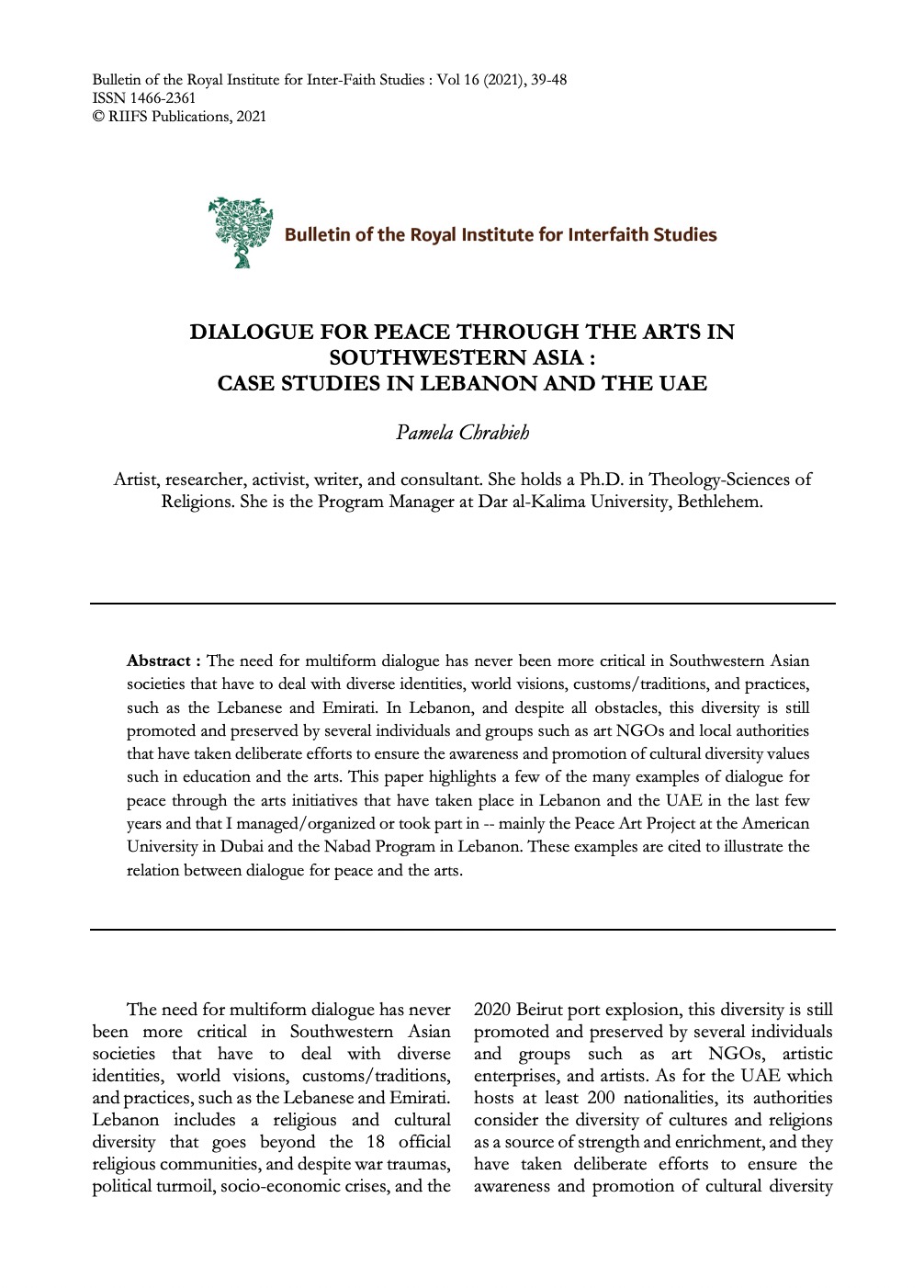
I am honoured to have my article “Dialogue for Peace Through the Arts in Southwestern Asia: Case Studies in Lebanon and the UAE” published in the Bulletin of the Royal Institute for Interfaith Studies (Vol. 16, 2021). Although written a few years ago, while I was managing the NABAD program at Dar al-Kalima University, its reflections on art as a catalyst for dialogue and peace remain as relevant today as ever. My gratitude goes to Dr. Renee Hattar, Director of the Royal Institute for Interfaith Studies in Amman, Jordan, for her continuous support and dedication to advancing interfaith dialogue on both local and regional levels.
Abstract: This article addresses the pressing need for dialogue in Southwestern Asia, where societies such as Lebanon and the UAE navigate complex layers of cultural, religious, and social diversity. In Lebanon, diversity persists despite the wounds of multiform war, political instability, socio-economic crises, and the 2020 Beirut port explosion, thanks to efforts by artists, NGOs, and local communities. In the UAE, the coexistence of more than 200 nationalities is embraced as a source of enrichment, supported by state initiatives, moral education curricula, and an expanding cultural sector.
Two case studies highlight the transformative role of the arts in cultivating dialogue for peace:
*The Peace Art Project – which I developed when I was an Associate Professor of Middle Eastern Studies at the American University in Dubai (2014–2018) -, brought students together through visual arts, poetry, music, food, and performances, fostering interreligious and intercultural exchange. These initiatives encouraged young people to challenge stereotypes, articulate visions of peace, and recognise themselves as active agents of social transformation.
The NABAD Program in Lebanon – which I managed in 2020–2021 – emerged as a response to the Beirut port explosion. It empowered artists and cultural organisations through art therapy for frontline workers, live and virtual concerts, community-based street art interventions, digital exhibitions via Arleb.org, and publications such as The Beirut Call. NABAD demonstrated how grassroots artistic practices can heal trauma, preserve memory, and foster collaboration across religious and cultural boundaries.
By examining these initiatives, the article underscores how the arts can serve as powerful vehicles for reconciliation and peacebuilding. They provide spaces for empathy, storytelling, and critical reflection, challenging violence and sectarianism while amplifying marginalized voices. Ultimately, the arts are portrayed not as decorative additions to dialogue but as essential practices that can reimagine collective futures and nurture inclusive, resilient societies.
Access the full article for free HERE: https://briifs.riifs.org/dialogue-for-peace-through-the-arts-in-southwestern-asia-case-studies-in-lebanon-and-the-uae/
 Dr. Pamela Chrabieh
Leave a comment